A buyer lands on your website at 11 p.m., views two three-bedroom listings, scrolls a third, and closes the tab. You never see it happen. By morning they're back on Instagram, halfway through someone's vacation reel — and the homes they were looking at are nowhere in sight.
That's the gap. Interest is real for about a day, then it cools. Most buyers still begin their home search online before they ever call anyone, according to NAR's 2025 Profile of Home Buyers and Sellers. So the place to be is wherever they browse next, and for most people that's Facebook and Instagram.
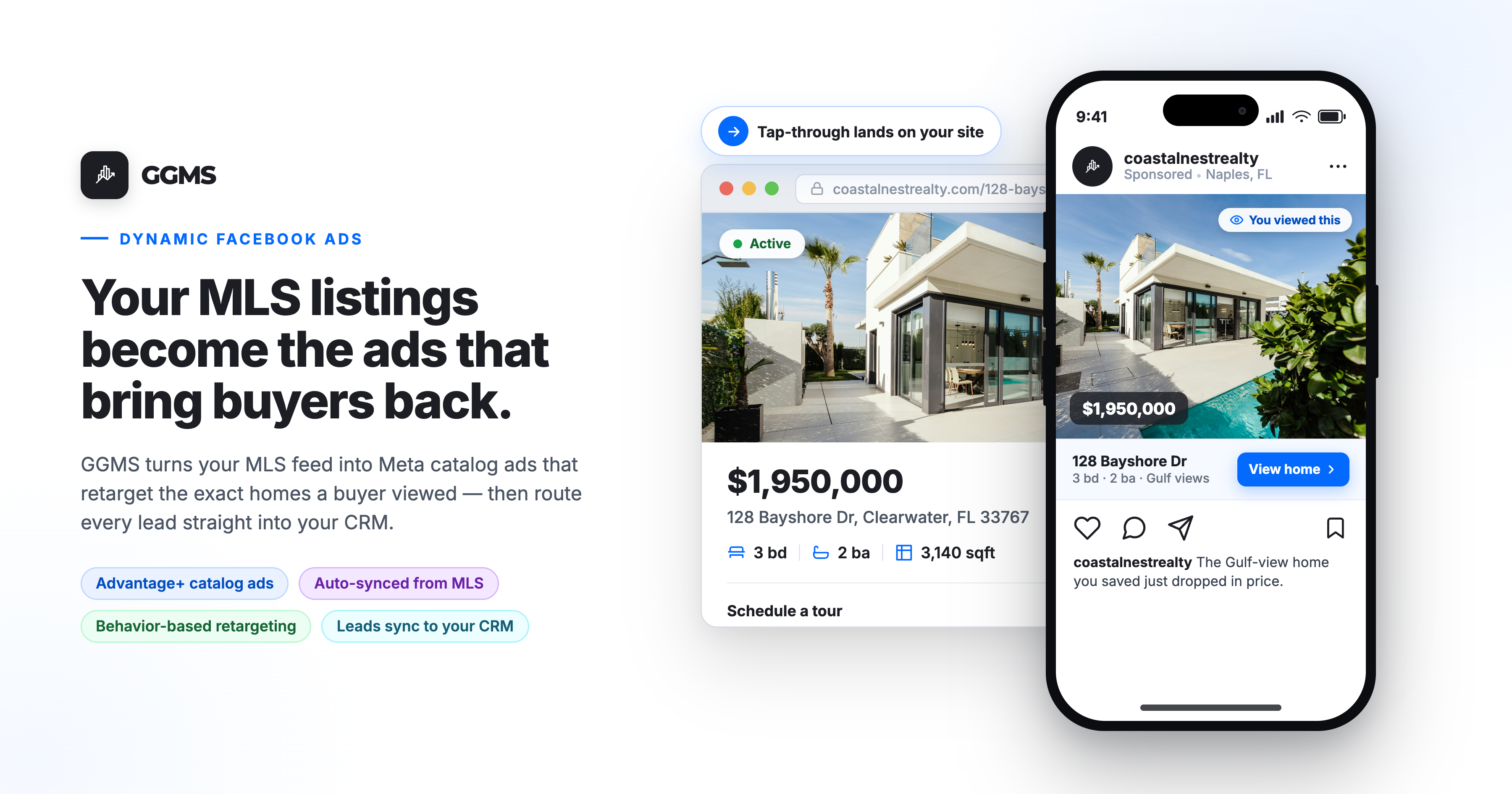
Dynamic Facebook ads for real estate close that gap. They pull the exact homes a person looked at — plus similar ones — back in front of that exact person, automatically, fed by your MLS data. We include this campaign in every GGMS package. Here's how the machinery actually works.
What dynamic Facebook ads for real estate actually are
Meta calls them Advantage+ Catalog Ads for Real Estate. You may have heard the older name — Dynamic Ads for Real Estate. Same idea, newer label.
Think about how a shopping site shows you the sneakers you looked at last week, on every site you visit afterward. These ads run on the same machinery, pointed at homes instead of products. Rather than building one ad per listing by hand, you connect a catalog of listings to Meta, and Meta decides which homes to show which people based on what they've already looked at.
A catalog is just a structured feed of your inventory: address, price, beds, baths, photos, and current status. Meta reads that feed and assembles the ad on the fly for each viewer.
How GGMS wires it to your MLS
This is the part most agents never want to touch, and the part where an owned platform earns its keep.
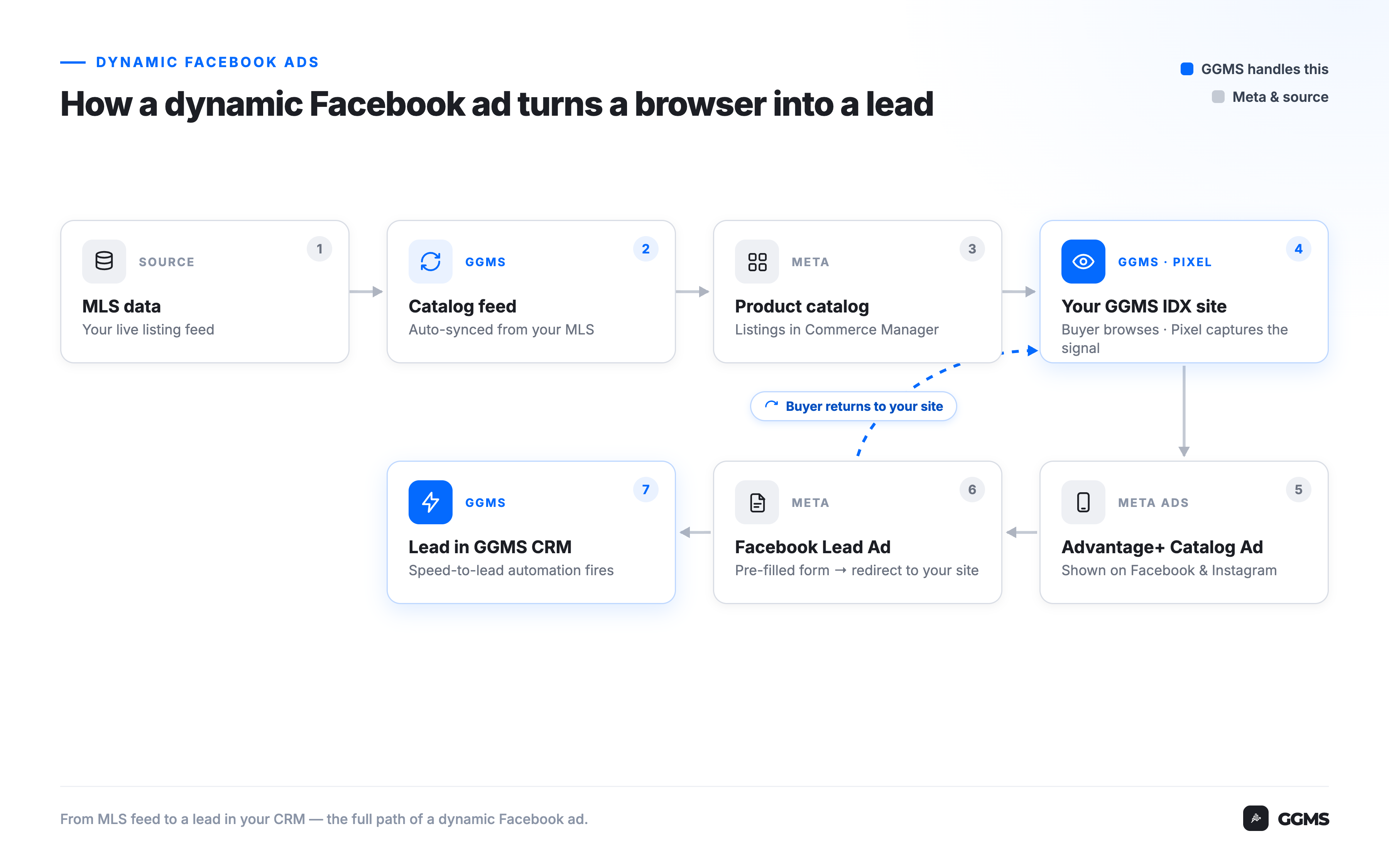
We build and sync the catalog feed from your MLS automatically. New listings flow in, sold ones drop out, prices update on their own. No spreadsheet exports, no re-uploading a feed every week.
Your Meta Pixel lives on your site. We install the Pixel from your own ad account on the GGMS-hosted IDX site we run for you. When someone browses listings there, that browsing becomes the signal Meta uses to choose which homes to show them later.
Here's the difference that's easy to miss: because we own and host both your IDX website and your GGMS CRM, the behavioral signal is native. The same browsing that triggers an ad is the same browsing your CRM can act on. Bolt-on setups have to stitch that across separate tools, and signals get lost in the seams.
The honest part — what you can and can't target
Real estate ads run under Meta's Housing Special Ad Category. Declaring it isn't optional. The moment you do, Meta removes a lot of the controls you might expect: no targeting by age, no gender, no ZIP code, a minimum 15-mile radius in the US, and no lookalike audiences. These rules trace back to a 2022 settlement between Meta and the US Department of Housing and Urban Development under the Fair Housing Act.
So if a vendor is still pitching "we'll laser-target the perfect buyer in one ZIP," that approach is both gone and non-compliant. We won't sell you something Meta won't run.
Here's why dynamic catalog ads still work without any of that: relevance comes from behavior, not demographics. The ad is built around what a person actually did — the homes they viewed on your site — not who they are. That's compliant by design, and it's a cleaner way to be relevant anyway. People who already looked are the people most likely to come back.
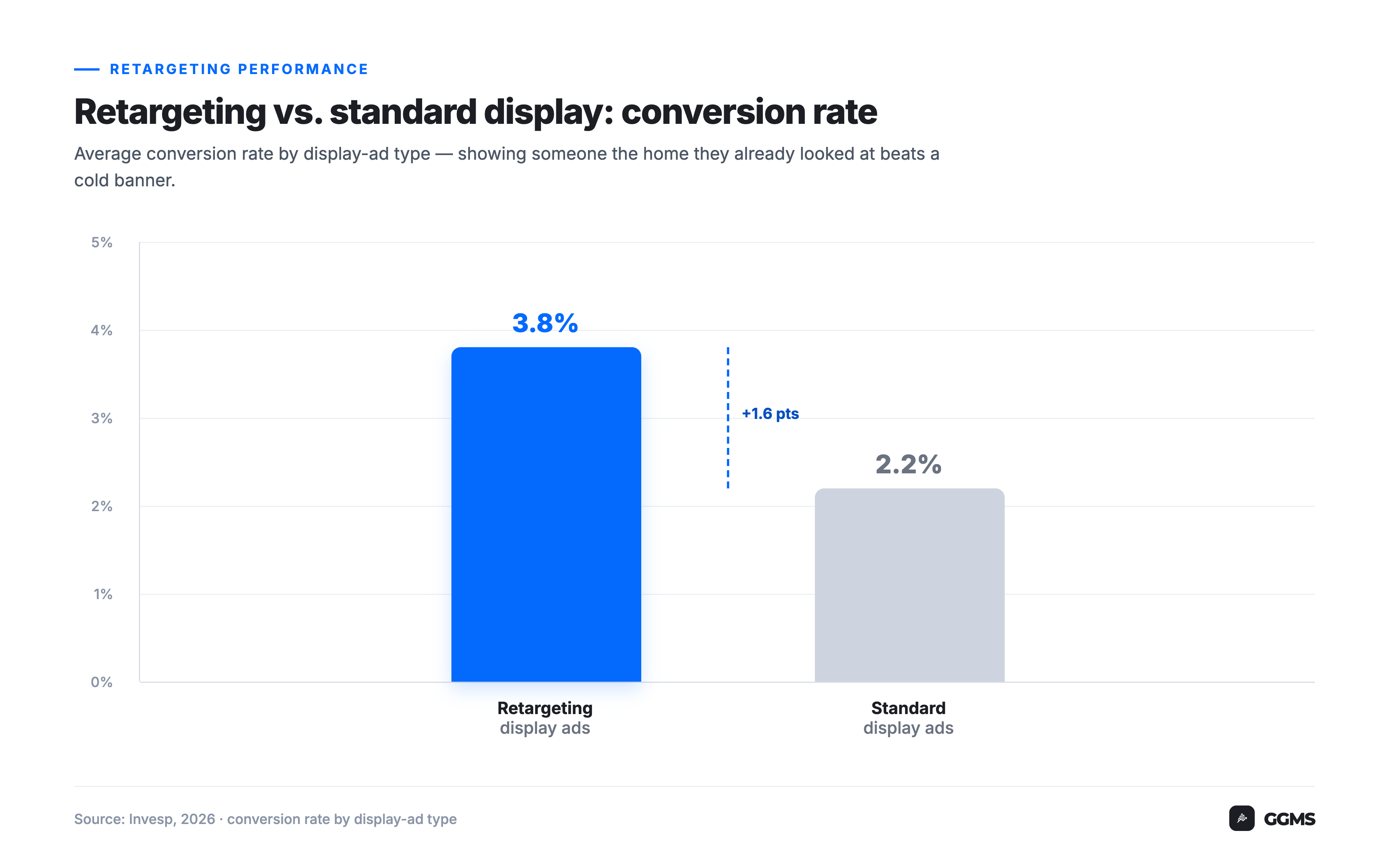
The data backs the approach. Site visitors who get retargeted are roughly 70% more likely to convert than visitors who aren't (Invesp). And letting the catalog pick the home matters: dynamic product retargeting converts about 34% higher than static retargeting ads (Criteo). Showing someone the home they actually looked at beats showing them a generic banner.
Your own listings, or the whole MLS?
Both work. We can run ads on just your listings, or on broader MLS inventory.
In our experience, broader inventory usually performs better. More homes means more chances to match what a given buyer is searching for, which gives Meta more room to find the right person. (Your MLS's display rules still apply, and we keep the feed inside them.) If you have a strong listing inventory of your own, we can lean there instead — it's a judgment call we'll make with you.
Where the lead actually goes
A pretty ad means nothing if the lead lands in a black hole. Here's the full path, start to finish:
- The catalog ad shows relevant homes in someone's Facebook or Instagram feed.
- A tap opens a Facebook Lead Ad — a form pre-filled with the person's name, email, and phone, so there's almost nothing to type. Less friction means more completed forms.
- On submit, they're redirected to your website — your GGMS IDX site, if that's where you're hosted — to keep browsing listings.
- The lead syncs straight into your GGMS CRM, and your speed-to-lead automations fire within seconds: a text, an email, an assignment, whatever you've set up. You also get real-time alerts the moment it lands, so a hot lead never sits.
That last step is where the money is. A pre-filled form delivers a lead while they're still on their phone, still thinking about the home. If your follow-up reaches them in that window, you're talking to someone who's actively looking.
Mid-post CTA: Want to see this running on your own listings? We'll walk you through a live example — reach out at sales@ggms.com.
What it looks like in a real month
Picture a buyer near Boise. One evening she browses a few listings on your site and leaves without filling anything out. Over the next few days, the homes she looked at — plus similar ones from the feed — show up in her feed. She taps one, the pre-filled form takes two seconds, and she's back on your site by the weekend. Meanwhile your CRM already texted her a hello.
For the numbers: in one GGMS account, this setup generated 709 leads in a single month from $1,200 in ad spend, reaching about 41,000 people across roughly 108,000 impressions. That works out to around $1.70 per lead.
One honest caveat: that's one account, one month — not a promise. Your results depend on your market, your budget, your photos, and how fast you follow up. But it shows what behavior-driven catalog ads can do when the plumbing underneath them is built right.
What you need to budget
The campaign is included in every GGMS package as a marketing perk — the setup, the MLS feed, the Pixel install, and the campaign build are on us. What you bring is the ad spend, which goes straight to Meta, not to us.
We recommend a minimum of $150 a month to give Meta enough signal to optimize, and $300 or more if you want real momentum. Below a floor, the algorithm simply doesn't get enough data to learn who to show your homes to, and performance suffers. Spend isn't the whole game, but starving the campaign is the fastest way to make it look like it doesn't work.
Frequently asked questions
What are dynamic Facebook ads for real estate?
They're ads that pull homes from a connected catalog of your listings and automatically show each person the properties most relevant to them, based on what they browsed on your website. Meta's current name for them is Advantage+ Catalog Ads for Real Estate, formerly Dynamic Ads for Real Estate.
How does my MLS data get connected to Facebook?
Your listings are fed into a product catalog inside Meta Commerce Manager. With GGMS, we build and sync that catalog from your MLS automatically — new listings are added, sold ones are removed, and prices update without any manual uploads from you.
Can I target a specific ZIP code or neighborhood with real estate ads on Facebook?
No. Real estate ads fall under Meta's Housing Special Ad Category, which removes ZIP code, age, and gender targeting and sets a minimum 15-mile radius in the US. These rules come from a Fair Housing settlement. Relevance instead comes from a person's behavior on your site, not their demographics.
Should I advertise my own listings or all MLS listings?
Both are options. Broader MLS inventory usually performs better because more homes give the system more chances to match each buyer, but a strong personal listing inventory can work well too. We help you decide based on what you have, and your MLS's display rules always apply.
How much do I need to spend?
The campaign is included in every GGMS package, but you supply the ad budget, which goes directly to Meta. We recommend at least $150 a month, and $300 or more for stronger momentum. Below a minimum, Meta doesn't get enough data to optimize.
Where do the leads go after someone clicks?
A click opens a pre-filled Facebook Lead Ad form. Once submitted, the person is redirected to your website to keep browsing, and the lead syncs directly into your GGMS CRM, where your speed-to-lead automations and real-time alerts fire within seconds.
Closing CTA: If you're already on GGMS, this campaign is sitting in your package right now — email support@ggms.com and we'll switch it on. If you're weighing a move, reach sales@ggms.com and we'll show you exactly what it looks like running on your listings.
.png)