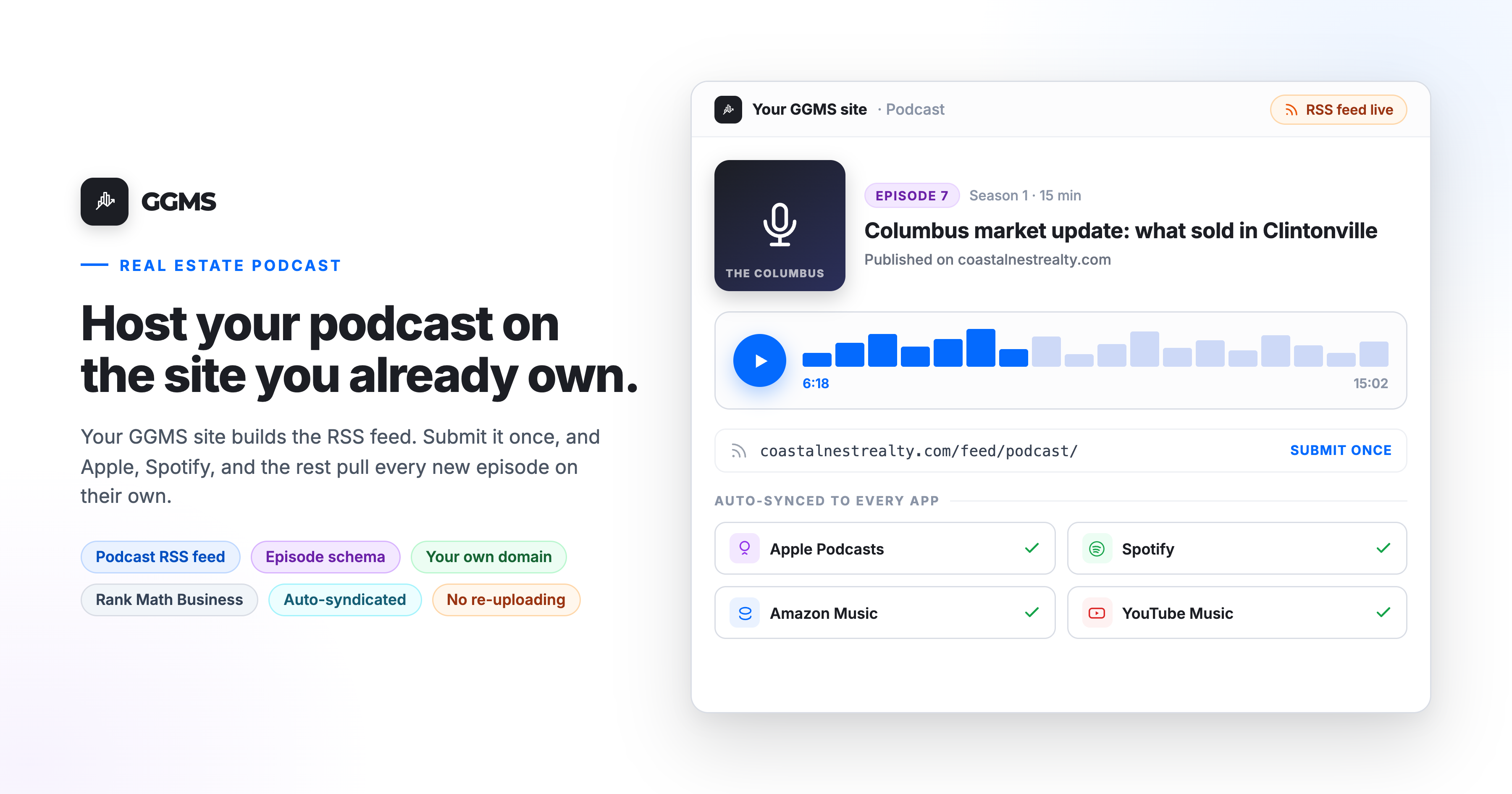
Yes, you can run a real estate podcast from your own website, and on a GGMS site most of the plumbing is already there. Every GGMS website includes Rank Math Business, which builds a real podcast RSS feed and the episode markup that podcast apps read. You record the show, point the feed at your audio, and submit it once to the apps your audience already uses.
Picture an agent in Columbus who records a fifteen-minute market update every month: what sold in Clintonville, where inventory is tight, what the latest rate move means for a move-up buyer. The episodes are useful. The question is where they live. Upload them to some random hosting page and the branding, the links, and the credit go to a domain that is not yours. Put the show on your own site and the page people land on, the links they share, and the search results all point back to you.
How does a podcast on your own website actually work?
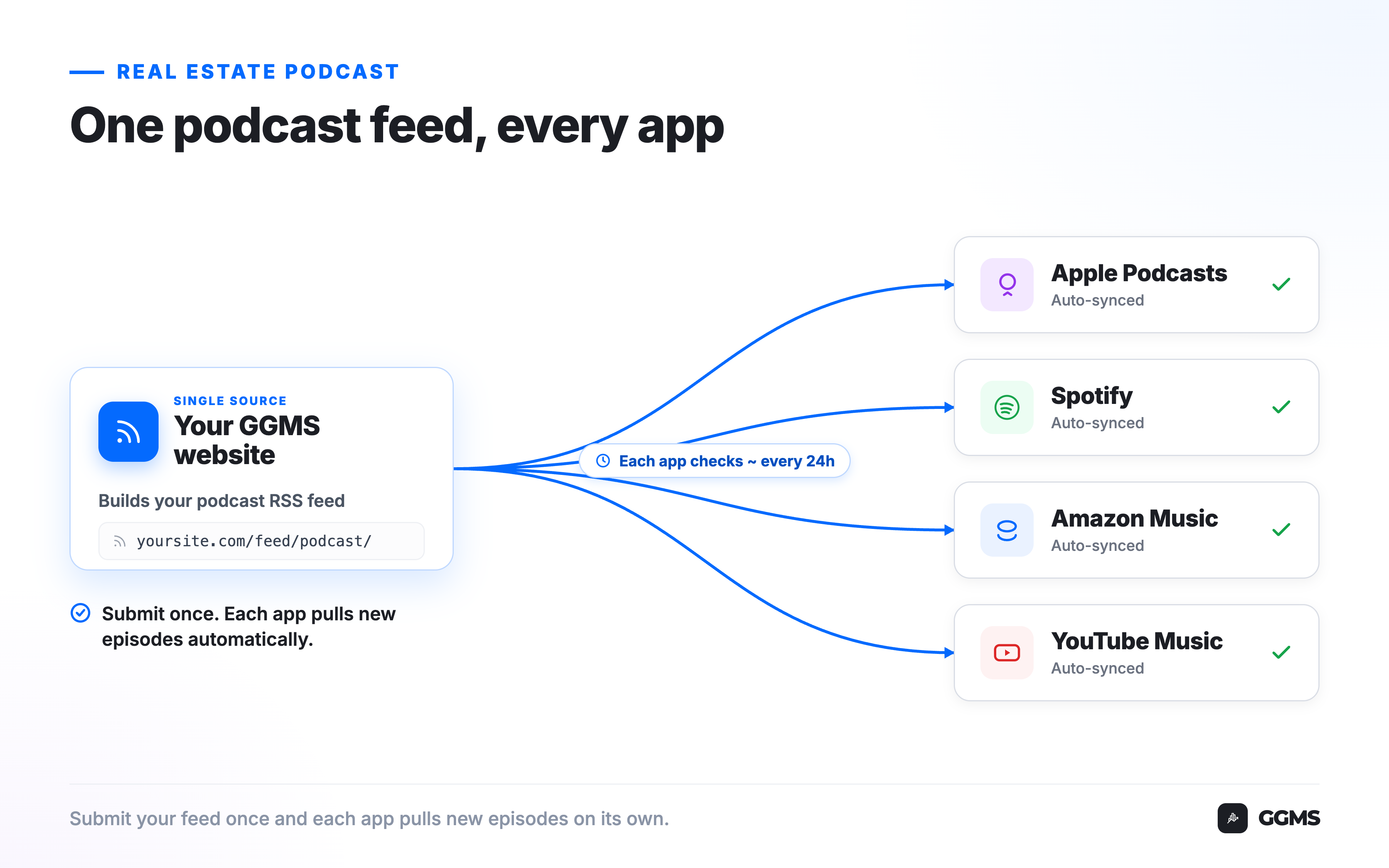
A podcast is really just an audio file plus an RSS feed, which is a machine-readable list of your episodes. Apple Podcasts, Spotify, and the rest read that one feed to list your show and pull each new episode automatically. On a GGMS site, Rank Math Business generates that feed for you from the episodes you publish.
The feed sits at a fixed URL on your site, something like yoursite.com/feed/podcast/. You submit that one URL to each podcast app a single time. From then on, the apps check your feed on a schedule, usually about every 24 hours, and add anything new on their own. You are never logging into five different platforms to re-upload the same episode.
Why host the show on your own site instead of a podcast platform?
Hosting the show on your own site keeps the public home of your podcast on your branded domain, where it builds your reputation instead of a third party's. You can still store the audio file wherever you like, but the feed, the show page, and the SEO value stay with you.
Real estate runs on reputation and staying top of mind, and the data backs that up. According to NAR's 2025 Profile of Home Buyers and Sellers, 43% of buyers found their agent through a referral, and 66% of sellers used a referral or an agent they had worked with before. A monthly show is one of the few marketing assets that keeps you in front of that network without feeling like an ad. The same report found that more than nine in ten buyers would use their agent again, which is the kind of goodwill a podcast is built to surface and spread.
It also strengthens the rest of your site. Episodes become pages, pages get show notes and transcripts, and those link to your listings, your buyer guides, and the local pages that help you show up in local search. One honest caveat: this is a compounding play, not an overnight switch. The first few episodes will not move your pipeline. The library you build over a year is what does the work.
Setting up your podcast channel
Your podcast channel is the show-level information every app displays: the name, the description, the cover art, the owner, and the category. In Rank Math you set this once under the SEO settings, and it applies to your whole feed.
A few fields are worth getting right the first time. The cover art has real requirements, since Apple Podcasts and others expect a square image between 1400 by 1400 and 3000 by 3000 pixels. The owner email is what the apps use to verify that the show is yours, so use an address you actually monitor. The category you pick is how listeners browsing an app can stumble onto you, so choose the closest fit rather than leaving it blank.
Adding each episode
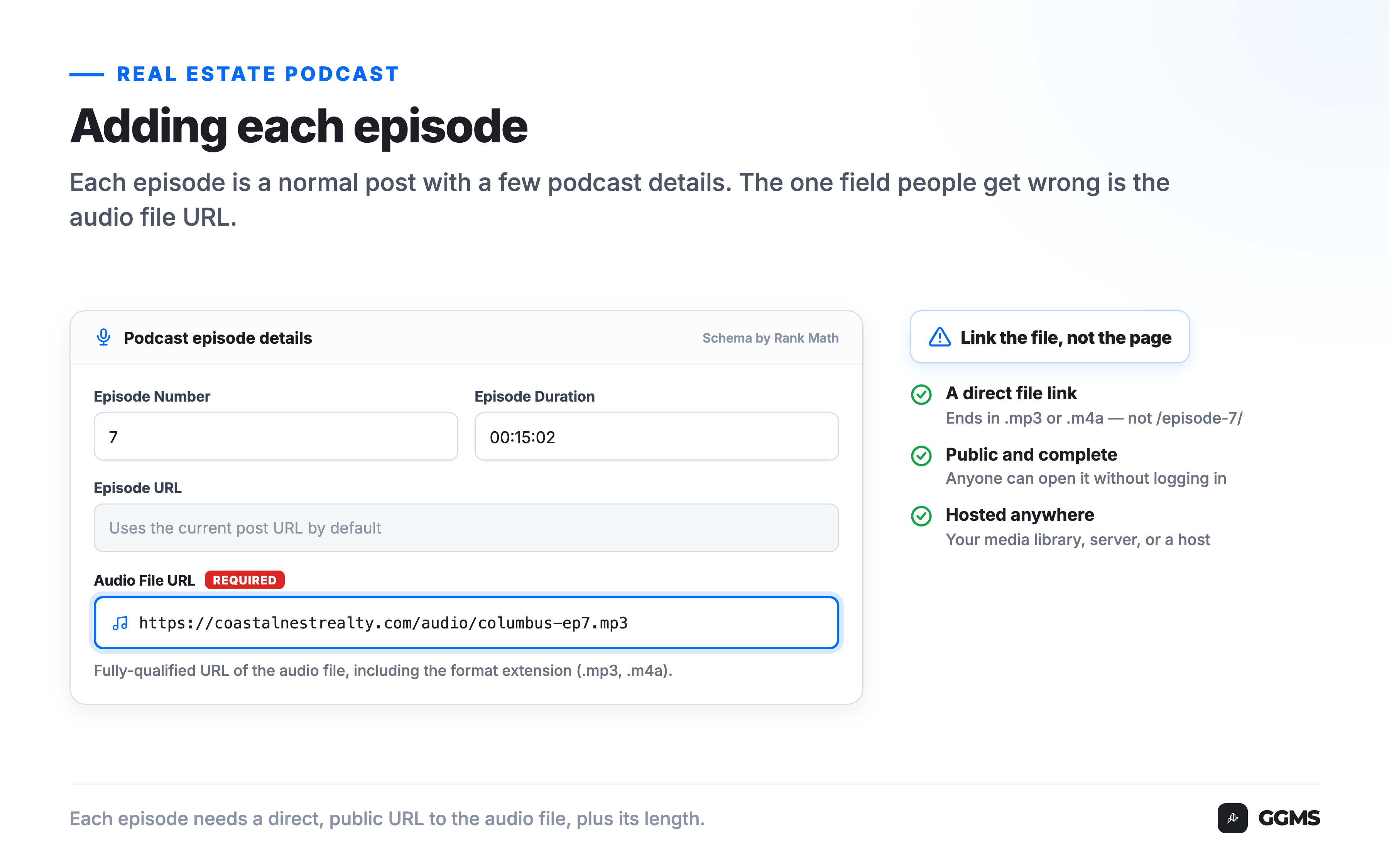
Each episode is a regular post on your site with podcast details attached: the audio file URL, the episode length, and an episode number. Rank Math folds those into your feed so the apps can play and order your episodes correctly.
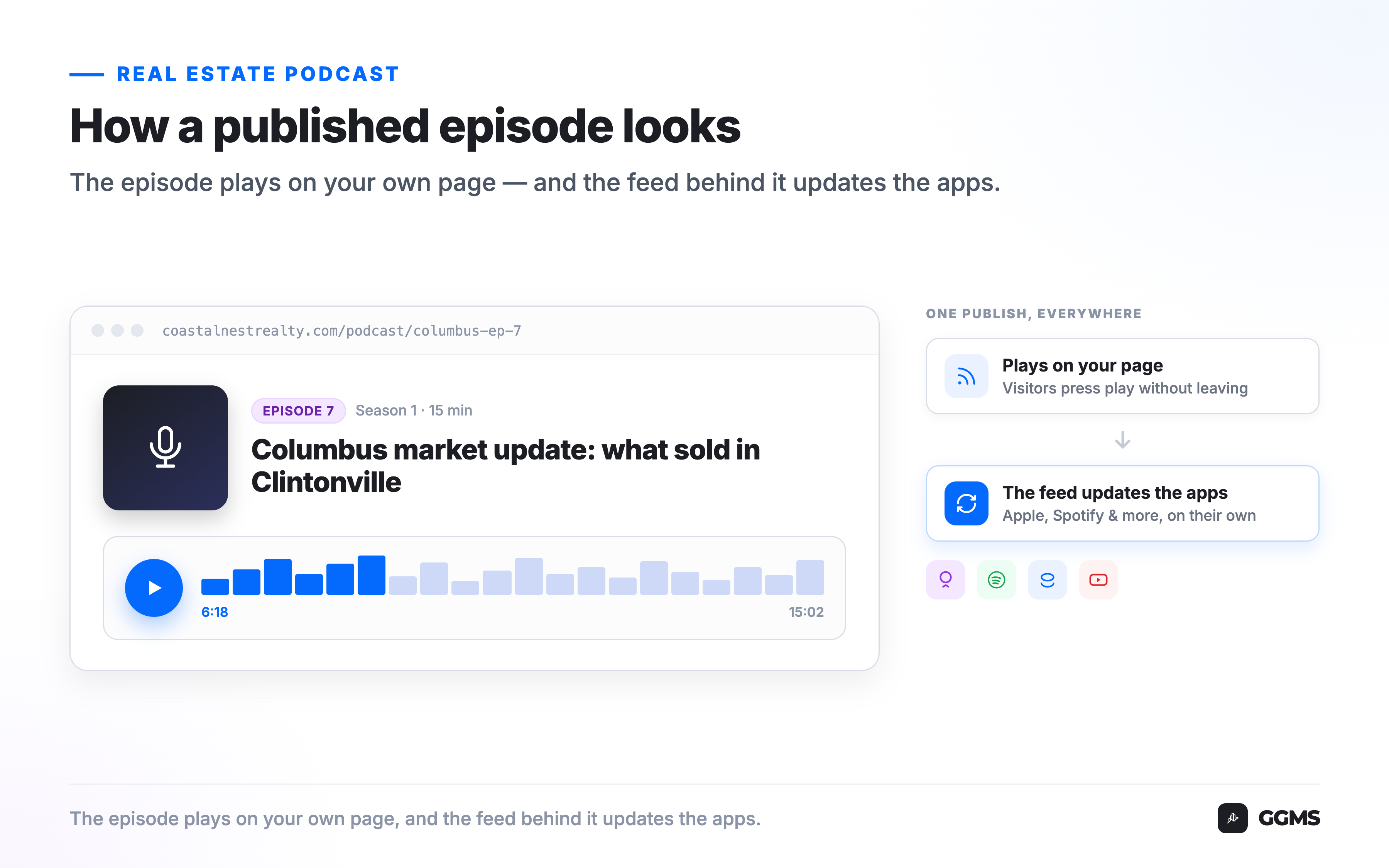
The audio file itself is flexible. It can live in your site's media library, on your own server, or with a third-party host, as long as the URL is public and complete. That is the one field people get wrong most often: the feed needs a direct, fully qualified link to the actual audio file, not a link to the page it sits on. You can also embed that audio on the post itself so a visitor can press play without leaving your site, the same way you would drop in a video.
Want to see the podcast settings on your own GGMS site before you record episode one? Reach out and we will walk you through exactly where everything lives. sales@ggms.com.
How do I get my podcast on Apple Podcasts, Spotify, and beyond?
You submit your feed URL once to each app: paste it into Apple Podcasts Connect, then into Spotify for Creators, then Amazon Music, and any others you want. Each one reviews the feed, approves it, and from that point pulls new episodes automatically. You publish once on your site and every app updates itself.
Submitting broadly matters because listening is split across apps. YouTube is now the single most-used service for podcasts, used by about a third of weekly podcast listeners, according to Edison Research's Infinite Dial 2025, while Apple Podcasts and Spotify still anchor the audio side. One feed lets you cover all of them without picking a favorite.
One note if you set podcasts up a couple of years ago: Google Podcasts shut down in 2024 and moved into YouTube Music, so there is nothing to submit there anymore. The feed-based approach is exactly what protects you from that kind of change. Apps come and go, but your feed stays put on your own domain.
Does a podcast and its schema actually help you get found?
A podcast helps mostly by widening where people can find you and by giving search and answer engines clean, machine-readable content to pull from. The episode schema marks up your show so those engines understand what it is. It is not a guaranteed rich result in Google, since Google scaled those back, so treat it as machine-readability rather than a snippet trick.
The audience is large enough to take seriously. Edison Research found that 55% of Americans age 12 and older are monthly podcast consumers, an all-time high. That is the same structural idea behind the schema and sitemaps that get your videos found in search: describe your content clearly, in a format engines can read, and you become eligible to surface in more places. Pair the show with video built into your website and you have an audio and visual library that compounds over time.
Frequently asked questions
Can I host a real estate podcast on my own website?
Yes. Your GGMS website includes Rank Math Business, which generates a podcast RSS feed and the episode schema that podcast apps read. You record your episodes, add the audio file URL and a few details to each one, and submit your feed to the apps you want to appear in. The show lives on your own domain.
Do I need a separate podcast host like Buzzsprout?
Not necessarily. Your GGMS site can generate the feed, and the audio file can live in your site's media library, on your own server, or with a third-party host. A dedicated host adds extras like built-in analytics and one-click directory submission, so the right choice depends on how much you want those features.
How do I get my podcast on Apple Podcasts and Spotify?
You submit your feed URL once in Apple Podcasts Connect and once in Spotify for Creators, then wait for each to review and approve it. After approval, both apps check your feed on their own, usually about every 24 hours, and add new episodes automatically. You do not upload episodes to each app by hand.
Does podcast schema improve my SEO?
Podcast schema makes your episodes machine-readable, so search engines and answer engines can understand and cite them, and so podcast apps read your feed correctly. It is not a guaranteed Google rich result, because Google scaled back those features. The durable value is clean, structured content, not a snippet trick.
Is a podcast worth it for a solo agent?
It can be, because a podcast keeps you visible to the network that already refers you business, and you do not need staff or a studio to start. A simple monthly market update recorded at your desk is enough. Treat it as a long-term reputation play rather than a quick source of leads.
Would rather not piece this together alone? We can set up your podcast channel and walk you through your first episode on your GGMS site. Email support@ggms.com to get started, or sales@ggms.com if you are not on GGMS yet and want to see how it fits.
.png)