.png)
Most real estate websites still rely on the same basic search experience: price, beds, baths, location, property type, and a few standard filters like pool, waterfront, or garage spaces. Those filters are important, and buyers will always need them, but they only cover the basics. They help people narrow the market, but they do not always help them find the specific type of property they actually have in mind.
The problem is that buyers do not only search by data points. They search by lifestyle, use case, and the small details that make one home stand out from another. Someone may not just want a condo in Clearwater. They may want a condo with Gulf views, a private elevator, and a premium kitchen. Another buyer may care more about a boat dock than the bedroom count. Someone else may be looking for no HOA, a guest house, acreage, or room for horses.
That is where advanced keyword search becomes valuable. It allows buyers to search the words and phrases inside listing descriptions, not just the structured MLS fields. That may sound like a small upgrade, but it can change how buyers search, how agents build ad campaigns, and how lead behavior is tracked inside the CRM.
The Best Property Details Are Often In The Listing Remarks
A lot of the most important property details are not always stored as clean MLS filters. They are often written into the listing remarks by the listing agent. That is where you see terms like Sub-Zero, Wolf, Viking, Thermador, Miele, Gulf views, boat dock, boat lift, guest house, in-law suite, outdoor kitchen, private elevator, horse barn, stalls, or no HOA.
Those words matter because they can completely change the value of a search. A waterfront buyer does not want to sort through every home near the water. They may specifically care about dockage, boat lifts, open water, deep water, seawalls, or Gulf views. A luxury buyer does not only care that a home is expensive. They may care about the kitchen, the view, the building, the finishes, and the amenities. A horse buyer is not just looking for acreage. They are looking for barns, stalls, paddocks, pasture, and equestrian-friendly property.
Basic IDX filters can get a buyer part of the way there, but keyword search gets closer to what they actually mean.
Why This Matters For Real Estate Ad Campaigns
This is where the feature becomes more than a website improvement. Advanced keyword search can also make real estate ad campaigns more effective.
A lot of agents run ads that send traffic to a generic IDX page. The ad might say “Search homes for sale in Tampa,” and when the buyer clicks, they land on a broad search page where they have to do all the work. They have to adjust filters, scroll through listings, refine the search, and hope they find something that matches what caught their attention in the first place.
A better approach is to build campaigns around more specific search results. Instead of sending people to a generic home search, an agent could run ads for “Waterfront homes with boat docks in St. Petersburg,” “Clearwater condos with Gulf views,” “No HOA homes with acreage near Tampa,” “Horse properties with barns near Ocala,” or “Luxury condos with private elevators and premium kitchens.”
Those campaigns are stronger because they speak to a more specific buyer. Even better, the click can send the buyer directly to IDX search results built around those keywords. The ad, the landing page, and the search results all line up. That creates a cleaner path from ad click to property engagement.
A Simple Example: Luxury Appliances And Gulf Views
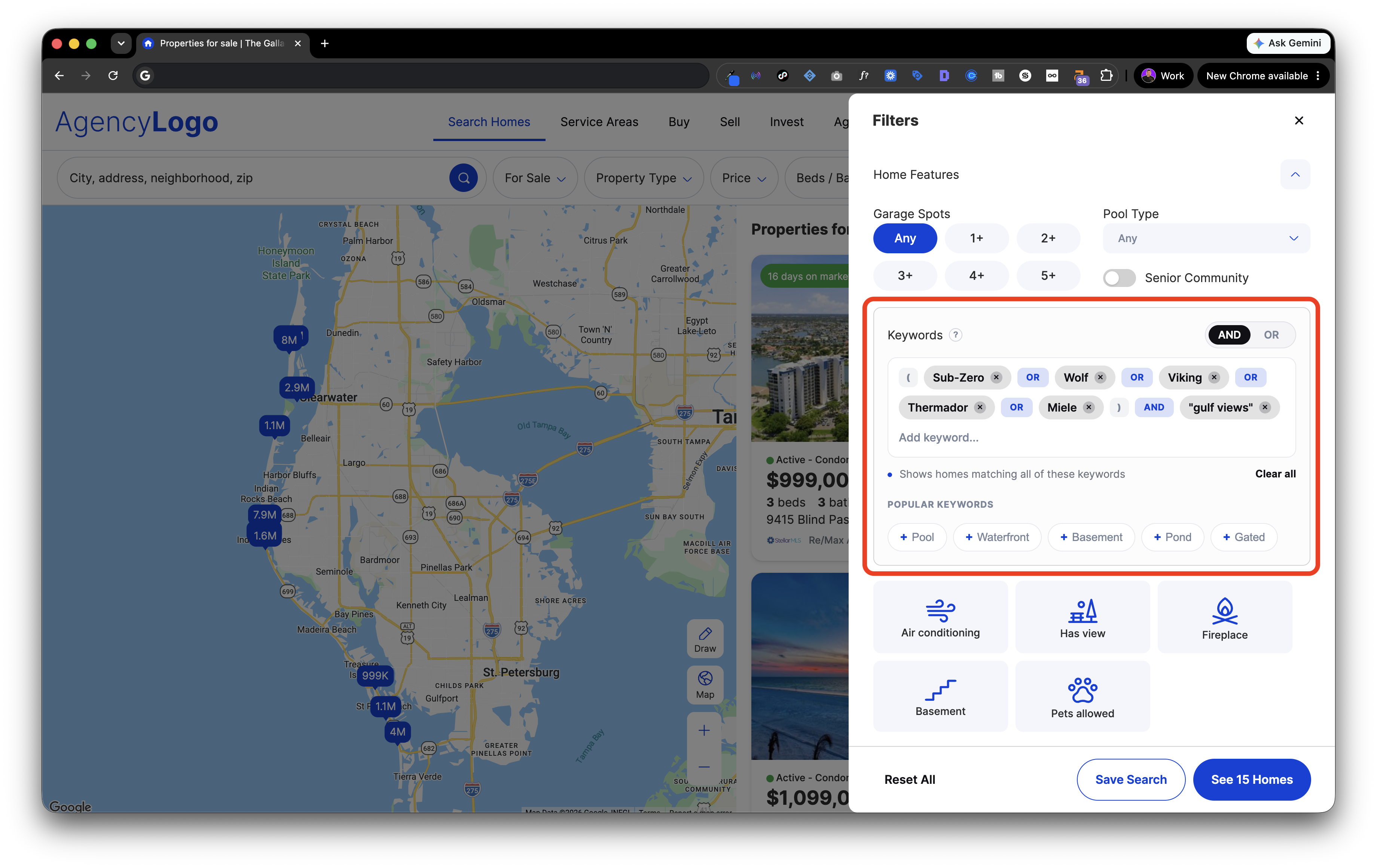
Let’s say an agent wants to target a luxury buyer looking for Gulf views and a high-end kitchen. A basic IDX search might let the buyer filter by city, price, condo, and maybe waterfront. That helps, but it does not fully capture the buyer’s intent.
With advanced keyword search, the agent can build a search around luxury appliance terms like Sub-Zero OR Wolf OR Viking OR Thermador OR Miele, then pair that with Gulf views. In plain English, the search is looking for homes that mention at least one premium appliance brand and also mention Gulf views in the listing description.
That is much stronger than simply searching for expensive homes. High price does not always mean the property has the view, kitchen quality, or lifestyle features the buyer wants. Keyword search helps narrow the results around the actual details that matter.
From an advertising standpoint, this becomes even more useful. An agent could run an ad for luxury condos with Gulf views and premium kitchens, then send that traffic to a search result that actually supports the promise made in the ad. That is better message match, and better message match usually creates a better user experience.
Specific Searches Usually Mean Stronger Intent
Most buyers start broad. They search by city, price range, and property type. But as they get more serious, their searches usually become more specific. They move from “homes for sale in Tampa” to things like “South Tampa homes with guest house,” “waterfront homes with boat lift,” “Clearwater condos with Gulf views,” “no HOA homes with acreage,” or “horse property with barn and pasture.”
Those searches are valuable because they tell the agent more about what the buyer actually wants. That is the difference between traffic and intent. Traffic is someone clicking around. Intent is someone showing a pattern.
When a buyer searches for “boat lift,” views several waterfront homes, saves two listings, and comes back later, that behavior means something. The agent now has context. They are no longer following up with a generic internet lead. They are following up with someone who has shown a clear property preference.
The CRM Piece Is What Makes It Really Valuable
Keyword search becomes much more powerful when that behavior is tracked inside the CRM. The search should not disappear after the page loads. An agent should be able to open a contact record and see which ad campaign brought the buyer in, what keywords they searched, which listings they viewed, which properties they saved, how often they came back, and how their search behavior changed over time.
There is a big difference between knowing someone clicked a buyer ad and knowing they clicked an ad for Gulf view condos, searched for Sub-Zero, viewed three luxury listings, and saved a waterfront property. That kind of activity gives the agent a much better picture of the lead.
It also changes the follow-up. Instead of asking, “Are you still looking for a home?” the agent can say, “I saw you were looking at homes with Gulf views and luxury kitchens. Are views and finishes two of the main things you are looking for?” That is a better conversation because it is tied to what the buyer actually did.
The ad creates the entry point. The IDX search captures the intent. The CRM gives the agent the context to follow up better. That is where the website and CRM start working together as a real lead generation system.
Keyword Search Is The Step Before Semantic Search
Advanced keyword search is valuable, but it is not the final destination. It is the practical step before a more intelligent search experience.
Where GGMS is headed is closer to semantic search powered by a large language model and supported by a RAG system, which stands for Retrieval-Augmented Generation. The idea is not just to match exact words. The goal is to understand the meaning behind what the buyer is asking for, while still grounding the results in real MLS data and listing information.
For example, a buyer may eventually type, “Show me waterfront condos in Clearwater with Gulf views, a private elevator, and high-end appliances under $2 million.” Another buyer may type, “Find homes near Tampa with room for horses, a barn, and no HOA.” Someone else may search, “I want a luxury home with a guest house, outdoor kitchen, pool, and privacy.”
A basic keyword search can look for exact words in the listing description. A semantic search experience would go further. It could understand that “high-end appliances” may relate to Sub-Zero, Wolf, Viking, Thermador, and Miele. It could understand that “room for horses” may relate to acreage, barns, stalls, pasture, paddocks, and equestrian use. It could understand that “guest house” may be similar to guest quarters, casita, detached suite, or in-law suite.
That is a much smarter search experience, but it requires more than a keyword box. To do it well, GGMS would need a RAG system that can connect natural-language buyer intent to actual listing data.
What A RAG System Would Do
A RAG system would help bridge the gap between how buyers describe what they want and how property data actually exists. MLS data, listing descriptions, property features, location information, and other relevant data would need to be organized in a way that can be searched more intelligently.
Instead of treating each listing only as a row in a database, the system would create a searchable knowledge layer around the meaning of the listing. When a buyer enters a natural-language search, the system would retrieve the most relevant listing information first. Then the language model would help interpret the buyer’s request and return results that better match the buyer’s intent.
The important part is that the language model would need to stay grounded in real listing data. It should not invent properties or make assumptions that are not supported by the MLS information. The RAG layer helps keep the search experience useful, intelligent, and connected to the actual inventory.
That is why this matters for real estate. Search can get smarter, but it still needs to be accurate.
Where GGMS Is Headed
This is the direction we are building toward with GGMS. We do not see IDX search as just a list of properties. We see it as part of a larger lead generation system that connects advertising, search behavior, CRM insight, and agent follow-up.
Advanced keyword search is one step in that direction. It gives buyers a better way to search today, and it gives agents a better way to build campaign landing pages around high-intent property searches. It also creates more meaningful behavioral data inside the CRM.
The bigger vision is to move from basic IDX filters, to advanced keyword search, to keyword-constructed ad campaign landing pages, to CRM tracking of search behavior, and eventually to semantic search powered by an LLM and grounded by a RAG system.
The goal is not just to have a better search box. The goal is to create a smarter property discovery experience where buyers can describe what they want, the system can understand the intent, and agents can see what their leads actually care about.
Final Thought
Advanced keyword search is not just a small IDX upgrade. It can change how buyers search, how agents build ad campaigns, and how leads are followed up with inside the CRM.
Buyers get a better search experience because they can search by the details that matter to them. Ad traffic lands on more relevant results because campaigns can be built around specific property intent. Agents get better insight because the CRM can show what the buyer searched, viewed, saved, and returned to.
Real estate search should not stop at price, beds, baths, and location. Buyers care about views, finishes, lifestyle, amenities, restrictions, property use, and the details that make a home worth pursuing.
Keyword search helps with that today. Semantic search powered by an LLM and supported by a RAG system is where this can go next.
That is the direction GGMS is building toward.
.png)